-95x98.png)
Introduction
Metabolism is the collection of chemical processes that allow living organisms to obtain energy, build cellular structures, and maintain physiological balance. Every cell in the body participates in metabolic activity, yet these processes must be carefully coordinated across different organs.
Hormones play a central role in this coordination. These chemical messengers are released by endocrine glands and travel through the bloodstream to regulate metabolism throughout the body. By controlling how nutrients are stored, used, and distributed, hormonal signals help maintain stable internal conditions even when external environments change.
Understanding how metabolism and hormonal regulation interact provides a foundation for studying many aspects of human biology, including energy balance, growth, stress responses, and metabolic diseases.
Concept
Metabolism consists of two major categories of biochemical processes.
Catabolism refers to reactions that break down molecules to release energy. For example, carbohydrates and fats can be broken down to generate ATP, the main energy currency of cells.
Anabolism involves reactions that use energy to build complex molecules such as proteins, lipids, and nucleic acids.
Because these processes occur continuously, the body must regulate when energy is stored and when it is used. Hormones provide this regulation by sending signals that coordinate metabolic activities among organs such as the liver, muscle, adipose tissue, and pancreas.
Key metabolic hormones include:
- insulin
- glucagon
- cortisol
- thyroid hormones
- adrenaline
Each of these hormones influences how nutrients are processed and how energy is allocated throughout the body.
Mechanism
Hormones regulate metabolism by binding to receptors on target cells. Once activated, these receptors initiate intracellular signaling pathways that modify enzyme activity or gene expression.
For example, insulin promotes glucose uptake and storage after a meal. It stimulates cells to absorb glucose from the bloodstream and encourages the liver and muscles to store energy as glycogen.
In contrast, glucagon acts when blood glucose levels fall. It stimulates the liver to release stored glucose into circulation, ensuring that the brain and other organs receive a constant energy supply.
Other hormones regulate metabolism under specific conditions. Cortisol helps mobilize energy during stress, while thyroid hormones influence the overall metabolic rate of the body.
Through these coordinated actions, hormones function as regulators that help maintain metabolic stability across different physiological states.
Systems Perspective
Metabolic regulation is not controlled by a single organ but emerges from coordinated communication between multiple physiological systems.
The pancreas monitors blood glucose levels and releases insulin or glucagon accordingly. The liver acts as a central metabolic hub that stores nutrients and releases them when needed. Muscle tissue consumes large amounts of energy during physical activity, while adipose tissue stores excess energy in the form of fat.
The brain also plays a regulatory role by integrating signals related to hunger, stress, and energy availability. Through neural and hormonal pathways, the brain helps coordinate metabolic responses across the body.
These interactions form a complex network in which organs constantly exchange signals to maintain energy balance.
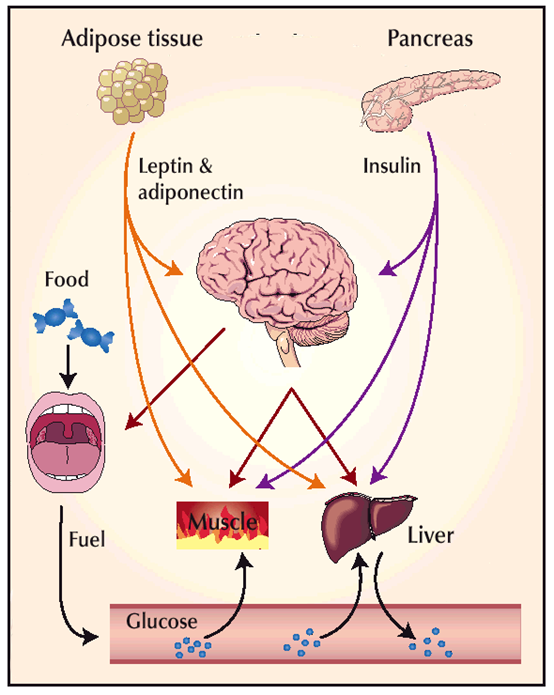
Figure 1. Systems-level map showing how hormones coordinate metabolism across major organs including the pancreas, liver, muscle, adipose tissue, and brain. Food intake provides metabolic fuel that enters the circulation as glucose, which is subsequently utilized or stored by peripheral tissues. The pancreas secretes insulin, which acts on the liver, skeletal muscle, and brain to regulate glucose uptake, storage, and metabolic balance. Adipose tissue releases the adipokines leptin and adiponectin, which influence central and peripheral metabolic pathways, including signaling to the brain, liver, and muscle. The brain integrates hormonal and nutritional signals and coordinates systemic energy balance through bidirectional communication with peripheral metabolic organs. Together, these interactions form an integrated network that maintains glucose homeostasis and whole-body energy regulation.
Health Connections
Proper hormonal regulation is essential for maintaining metabolic health. When hormonal signaling becomes disrupted, metabolic balance can be disturbed.
For example, in type 2 diabetes, cells become less responsive to insulin, resulting in elevated blood glucose levels. Similarly, excessive cortisol release during chronic stress can alter energy metabolism and promote metabolic imbalance.
Understanding hormonal control of metabolism therefore helps explain the biological basis of many metabolic disorders and highlights the importance of maintaining balanced physiological regulation.
Integrative Perspective
The relationship between metabolism and hormonal regulation illustrates how biological systems maintain dynamic balance. Hormones allow the body to respond to changes in food intake, physical activity, and environmental stress while preserving internal stability.
This principle of coordinated regulation is a central theme in modern physiology. It also reflects a broader understanding that health emerges from interactions among multiple systems rather than from isolated biochemical processes.
Studying metabolic regulation therefore provides valuable insight into the complex networks that sustain life.
Key Takeaways
• Metabolism includes energy-producing catabolic reactions and energy-building anabolic reactions.
• Hormones coordinate metabolic processes across different organs.
• Insulin and glucagon are key regulators of blood glucose balance.
• The liver, muscle, adipose tissue, pancreas, and brain work together to regulate energy metabolism.
• Disruptions in hormonal regulation can contribute to metabolic diseases.