-95x98.png)
Introduction
Health is shaped by more than one factor. Some traits and disease risks are influenced by the genes we inherit from our parents, while others are affected by the environments we live in, the food we eat, the air we breathe, the stress we experience, and the habits we develop over time. Modern biology shows that health does not arise from genes alone or environment alone, but from the continuous interaction between the two.
This idea is central to medicine. Two people may share a similar genetic risk for a disease, yet have very different outcomes depending on lifestyle, social conditions, environmental exposures, and access to healthcare. In the same way, people exposed to similar environments may respond differently because of biological differences in how their bodies process stress, nutrients, toxins, or infection.
Understanding how genes and environment work together helps explain why health is dynamic rather than fixed. It also helps us move beyond the mistaken idea that biology is destiny. Genes influence how the body is built and regulated, but environmental conditions can modify how strongly those genetic tendencies are expressed across the lifespan.
Concept
Genes are segments of DNA that contain instructions for building proteins or regulating biological processes. These instructions help shape many aspects of human biology, including growth, metabolism, immune function, and brain development. Some diseases are caused mainly by changes in a single gene, but many common disorders are influenced by the combined effects of many genes, each contributing a small amount to overall risk.
Environment, in biology and medicine, refers broadly to all external and internal conditions that affect the body. This includes not only pollution, chemicals, pathogens, and climate, but also diet, exercise, sleep, psychological stress, social relationships, and early-life experiences. Even the prenatal environment can influence later health.
The key idea is gene–environment interaction. This means that the effects of genes often depend on environmental conditions, and the effects of environmental exposures often depend on genetic background. For example, some individuals may be more sensitive to air pollution, dietary imbalance, or chronic stress because of inherited differences in metabolism, inflammation, or detoxification pathways.
Health can therefore be understood as the outcome of an ongoing dialogue between biological potential and lived experience. Genes provide a framework, but the environment helps shape how that framework is expressed in real life.
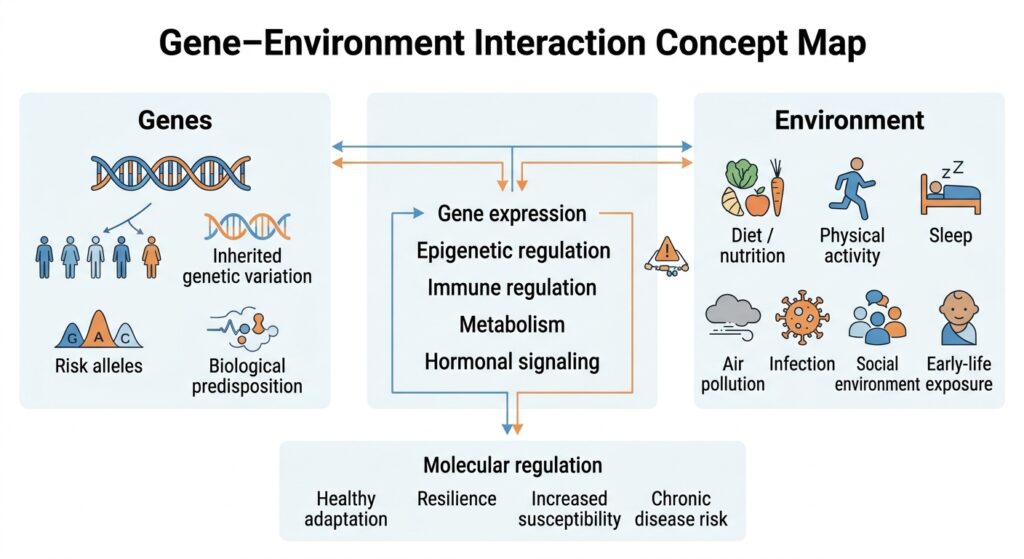
Figure 1. Gene–environment interaction concept map. Health outcomes arise from the interaction between inherited genetic variation and environmental influences such as nutrition, lifestyle, stress, infection, and pollution. Genes can modify sensitivity to environmental exposures, while environmental factors can influence how genes are expressed and how disease risk develops over time.
Mechanism
How does the environment influence biology at the molecular level? One important answer lies in gene regulation. Not all genes are active in every cell at every time. Cells must turn specific genes on or off depending on their function and the signals they receive. Environmental factors can affect these regulatory processes.
A major mechanism involves epigenetic regulation. Epigenetics refers to chemical modifications that influence gene activity without changing the DNA sequence itself. Two well-known examples are DNA methylation and chromatin modification.
DNA methylation usually involves the addition of small chemical groups called methyl groups to DNA. In many cases, this reduces the expression of nearby genes. Chromatin, the complex of DNA and proteins in the nucleus, can also become more open or more compact. When chromatin is open, genes are more accessible for transcription; when it is tightly packed, genes are less easily expressed.
These regulatory systems are important because they allow cells to respond to changing conditions. Nutrients, hormones, toxins, inflammation, sleep patterns, and stress-related signaling can all influence molecular pathways that affect gene expression. In this way, the environment can alter cellular behavior without rewriting the genetic code.
For example, chronic stress may affect hormonal and neural signaling pathways that influence immune and metabolic gene regulation. Nutritional imbalance may alter pathways related to insulin signaling, lipid metabolism, or oxidative stress. Environmental pollutants may trigger inflammation, DNA damage, or changes in detoxification pathways. Over time, repeated exposures can shift the body toward greater disease vulnerability.
At the same time, the body is not passive. Cells have repair systems, buffering mechanisms, and adaptive responses that help maintain stability. Whether an exposure leads to long-term harm often depends on its intensity, duration, developmental timing, and the resilience of the individual organism.
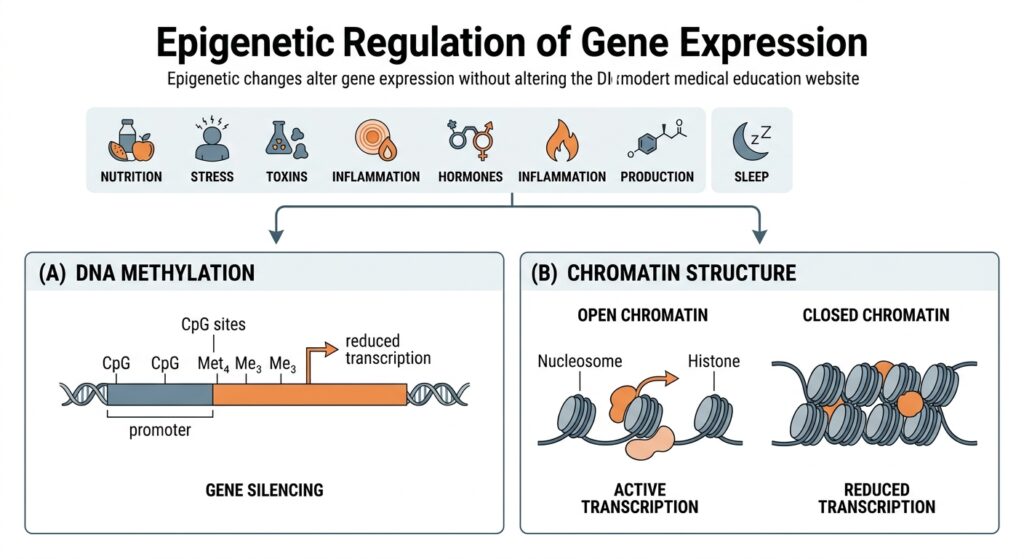
Figure 2. Epigenetic regulation of gene expression. Environmental signals can influence gene activity through epigenetic mechanisms such as DNA methylation and changes in chromatin structure. These modifications do not alter the DNA sequence itself, but they can increase or decrease the accessibility of genes for transcription, thereby affecting cellular function and long-term health.
Systems Perspective
The interaction between genes and environment does not occur in one organ only. It unfolds across multiple body systems.
The nervous system detects stress, social experience, and sensory input, then translates them into neural and hormonal signals. The endocrine system distributes hormones that regulate metabolism, growth, reproduction, and adaptation. The immune system responds to infection and tissue damage, but is also influenced by nutrition, sleep, and psychological stress. The metabolic system, including the liver, adipose tissue, muscle, and pancreas, processes nutrients and energy while responding to both genetic programming and environmental habits.
Because these systems are interconnected, an environmental influence in one area may affect many others. For instance, poor sleep can alter hormone regulation, reduce insulin sensitivity, increase inflammatory signaling, and affect mood and cognition. Air pollution may not only harm the lungs, but also contribute to oxidative stress, vascular dysfunction, and systemic inflammation. Early-life adversity may influence neural development, stress regulation, immune balance, and later disease susceptibility.
Timing also matters. Some periods of life are especially sensitive to environmental effects, including fetal development, infancy, childhood, adolescence, and aging. During these windows, environmental signals can have lasting effects on organ development and biological regulation. This is why maternal nutrition, toxin exposure, infection, and stress during pregnancy can influence long-term health in offspring.
A systems perspective therefore shows that health emerges from coordinated regulation across the whole body. Gene–environment interaction is not a single event, but a lifelong process involving communication among cells, tissues, organs, and social environments.
Health Connections
The relationship between genes and environment helps explain many common diseases. Most major chronic disorders do not result from one cause alone. Instead, they emerge from accumulated interactions between inherited susceptibility and long-term exposure patterns.
Examples include:
– Type 2 diabetes, in which genetic predisposition interacts with diet, physical inactivity, sleep disruption, and obesity
– Cardiovascular disease, influenced by lipid metabolism, blood pressure regulation, inflammation, smoking, and environmental stress
– Asthma, shaped by immune-related genes together with allergens, air pollution, and respiratory infections
– Depression and anxiety disorders, affected by genetic variation, early-life stress, social environment, and neurobiological regulation
– Certain cancers, which may involve inherited risk together with smoking, radiation, infection, chemical exposure, diet, and aging
This knowledge has practical value. It supports the development of preventive medicine, public health, and personalized care. If we understand which environments increase risk and which populations are more vulnerable, we can design better strategies for protection. These may include reducing pollution, improving nutrition, promoting physical activity, supporting mental health, encouraging healthy sleep, and identifying high-risk individuals earlier.
Importantly, recognizing genetic influence should not lead to fatalism. In many cases, healthy environments and behaviors can reduce risk significantly, even when inherited susceptibility is present. Likewise, unfavorable environments can increase disease risk even in people without strong genetic predisposition.
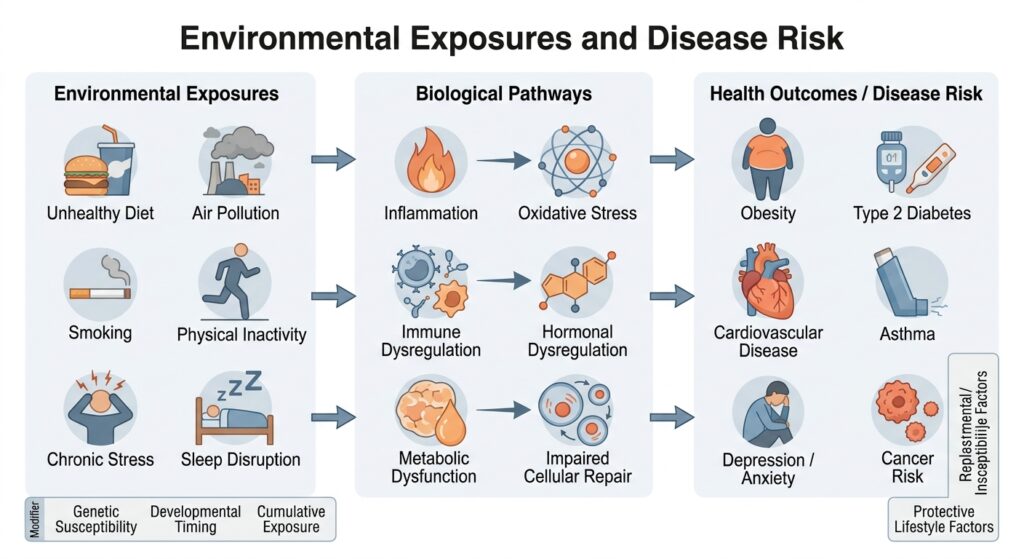
Figure 3. Environmental exposures and disease risk. Environmental factors such as diet, air pollution, smoking, physical inactivity, chronic stress, and sleep disruption can influence metabolism, inflammation, immune regulation, and cellular repair. Their long-term effects on health depend in part on genetic background, developmental timing, and cumulative exposure.
Integrative Perspective
Across many medical traditions, health has often been described as a state of balance between the body and its environment. Although traditional systems use concepts different from modern molecular biology, they frequently emphasize that external conditions, daily habits, emotional states, and internal regulation are deeply connected.
Modern biomedicine provides a mechanistic framework for this insight. Genes do not act in isolation; they function within cells that are constantly responding to nutrition, behavior, stress, microbes, toxins, and social conditions. In this sense, health reflects not only biological inheritance, but also the quality of the relationship between the organism and its surroundings.
This perspective encourages a broader view of medicine. Good health depends not only on treating disease after it appears, but also on shaping supportive environments that allow biological systems to function well. Prevention, education, and early intervention are therefore as important as diagnosis and therapy.
Key Takeaways
– Genes provide biological instructions, but they do not determine health outcomes by themselves.
– Environmental factors such as diet, stress, pollution, sleep, and lifestyle can influence how genes are expressed.
– Gene–environment interaction helps explain why people respond differently to similar exposures.
– Epigenetic mechanisms, including DNA methylation and chromatin changes, link environmental signals to gene regulation.
– Many common diseases arise from the combined effects of inherited risk and long-term environmental influences.
– Health is best understood as a dynamic process shaped by biology, behavior, and environment across the lifespan.