
Introduction
Sleep is a fundamental biological process that supports physical health, brain function, and emotional well-being. Although sleep occupies nearly one-third of human life, it was once considered a passive state in which the body simply rested. Modern research has shown that sleep is an active and highly regulated process essential for maintaining many physiological systems.
During sleep, the brain reorganizes information, the immune system strengthens its defenses, and the body carries out important repair processes. Insufficient or poor-quality sleep can disrupt these processes and contribute to a wide range of health problems.
Understanding why sleep is essential can help people make healthier decisions about daily routines and long-term well-being.
Concept
Sleep is a recurring biological state characterized by reduced awareness of the external environment and coordinated changes in brain activity. It is controlled by complex interactions between the brain, hormones, and internal biological clocks.
Human sleep typically follows a repeating cycle consisting of two main stages:
Non-REM (NREM) sleep
This stage includes progressively deeper levels of sleep and is important for physical restoration and energy conservation.
REM (Rapid Eye Movement) sleep
This stage is associated with vivid dreaming and increased brain activity. REM sleep plays a role in memory consolidation and emotional regulation.
Throughout the night, the brain alternates between these stages in cycles lasting about 90 minutes.

Figure 1. The human sleep cycle alternates between non-REM and REM stages throughout the night. Human sleep is organized into repeating cycles of approximately 90 minutes, alternating between non-rapid eye movement (NREM) sleep and rapid eye movement (REM) sleep. NREM sleep progresses through lighter to deeper stages and is particularly important for physical restoration and energy conservation, whereas REM sleep is associated with vivid dreaming, memory consolidation, and emotional regulation. Across the night, deeper NREM sleep is more prominent in the earlier cycles, while REM periods tend to lengthen toward morning.
Mechanism
Sleep is regulated by two major biological systems.
The first is the circadian rhythm, a roughly 24-hour internal clock that helps regulate sleep and wake cycles. This rhythm is strongly influenced by light exposure and is coordinated by a brain structure known as the suprachiasmatic nucleus.
The second system is sleep pressure, which gradually increases during waking hours. As the brain remains active throughout the day, certain chemical signals accumulate and promote the need for sleep.
Together, circadian rhythm and sleep pressure determine when the body feels alert and when it becomes ready for sleep.
During sleep, the brain also activates specialized processes that support maintenance and repair.

Figure 2. During sleep, the brain activates the glymphatic system, which helps remove metabolic waste products. Schematic illustrating the glymphatic system, a brain-wide clearance pathway that becomes more active during sleep. In this state, cerebrospinal fluid (CSF) flows along perivascular spaces, exchanges with interstitial fluid, and facilitates the removal of metabolic waste products from brain tissue. This process supports neural maintenance and may contribute to the restorative functions of sleep.
Systems Perspective
Sleep affects many systems throughout the body.
The brain uses sleep to consolidate memories and regulate emotional responses. The immune system becomes more active during sleep, helping the body prepare to fight infections. The metabolic system also depends on adequate sleep to regulate hormones related to appetite and energy balance.
When sleep is insufficient, these systems may become disrupted. Short sleep duration has been associated with increased risks of metabolic disorders, cardiovascular disease, and impaired cognitive performance.
Because sleep influences so many physiological processes, it is often described as a cornerstone of overall health.
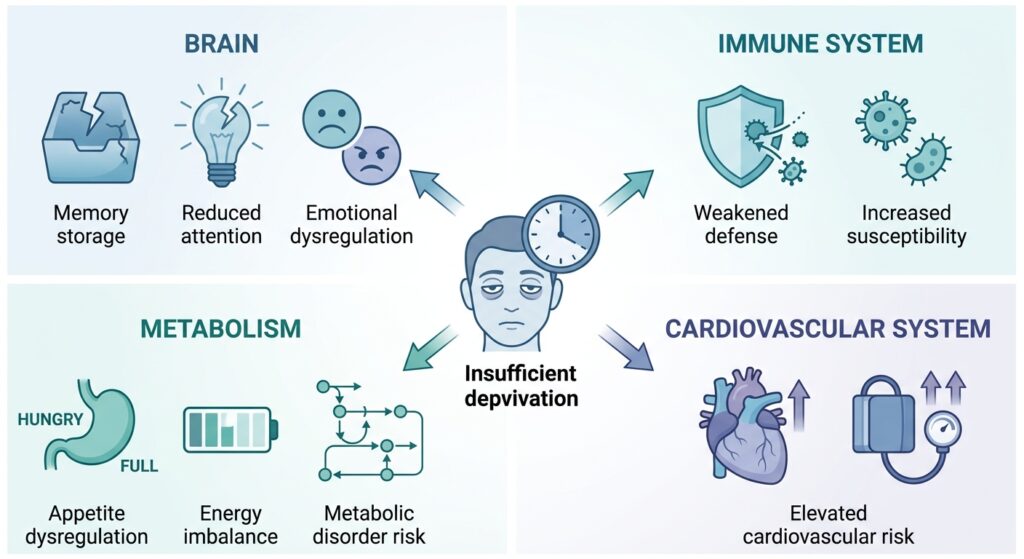
Figure 3. Insufficient sleep can affect multiple systems, including the brain, immune function, and metabolism. Diagram summarizing the systemic consequences of insufficient sleep. Inadequate sleep can impair brain functions such as memory, attention, and emotional regulation; disrupt immune defenses; and alter metabolic regulation of appetite and energy balance. Short sleep duration is also associated with increased risks of metabolic disorders, cardiovascular disease, and reduced cognitive performance, underscoring the central role of sleep in overall health.
Healthy Sleep Habits
Good sleep hygiene can support healthy sleep patterns.
Helpful habits include:
• maintaining a regular sleep schedule
• reducing screen exposure before bedtime
• keeping the sleeping environment dark and quiet
• avoiding caffeine late in the day
• engaging in regular physical activity
Developing consistent sleep habits can improve sleep quality and support long-term health.
Key Takeaways
• Sleep is an active biological process essential for brain and body function.
• Human sleep cycles alternate between non-REM and REM stages.
• Circadian rhythms and sleep pressure regulate sleep timing.
• During sleep, the brain removes metabolic waste and consolidates memory.
• Chronic sleep deprivation can affect cognitive, immune, and metabolic health.