-95x98.png)
Understanding Health: From Cells to Biological Systems
A bridge between molecular biology, physiological systems, and medical concepts
Introduction
Health often feels like a simple concept. We ——describe someone as healthy when their body functions well, when they have energy, and when illness is absent. Yet from a biological perspective, health is remarkably complex. The human body contains trillions of cells performing countless chemical reactions every second. These processes must be carefully coordinated to maintain stability in a constantly changing environment.
How does the body achieve this stability? How do billions of cells work together to support life? Modern biomedicine approaches these questions by studying life across multiple levels of organization—from molecules and cells to organs, physiological systems, and the whole organism.
Understanding health therefore requires more than memorizing facts about organs or diseases. It requires recognizing how biological mechanisms interact to form dynamic systems. This layered perspective forms the foundation of modern biomedical science and provides the framework for the Biomedicine Bridge.
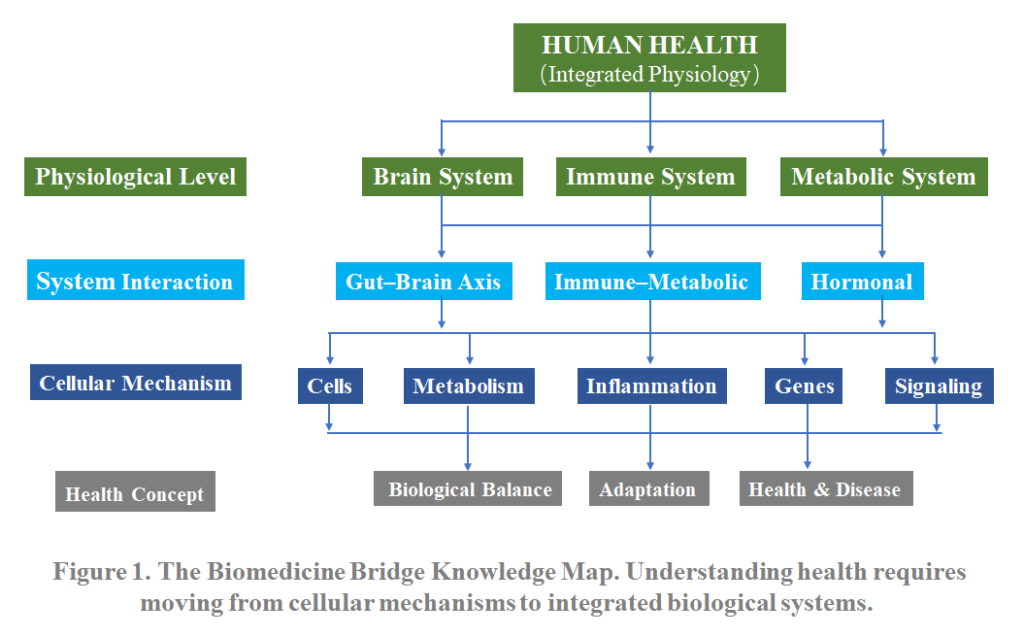
The Knowledge Map illustrates how biological understanding moves across several levels: core cellular mechanisms, integrated physiological systems, and broader medical concepts related to health and disease.
The Cellular Foundations of Life
At the most fundamental level, life is built upon cells. Cells are the smallest units capable of performing the essential functions required for life: metabolism, communication, adaptation, and reproduction.
Inside each cell, a vast network of molecular processes operates continuously. One of the most important is metabolism, the set of chemical reactions that convert nutrients into energy and cellular building blocks. Metabolism powers nearly every biological process, from muscle contraction to brain activity.
Cells must also communicate with one another. This communication occurs through cell signaling, in which molecules such as hormones, neurotransmitters, or cytokines transmit information between cells. Through these signals, cells coordinate their activities and respond to changes in their environment.
Another essential component is genetic information. Genes stored in DNA provide instructions for producing proteins that regulate cellular function. However, genes do not act alone; their activity is influenced by environmental conditions, metabolic signals, and cellular interactions.
Together, metabolism, gene regulation, immune activity, and signaling networks form the core biological mechanisms that sustain life. These mechanisms represent the foundation of modern biomedical research.
Yet understanding individual cellular processes is only the beginning. In living organisms, cells rarely act in isolation.
Biological Systems and Integration
Cells organize into tissues and organs, which in turn form physiological systems such as the nervous system, immune system, and metabolic system. These systems constantly interact with one another, forming an integrated biological network.
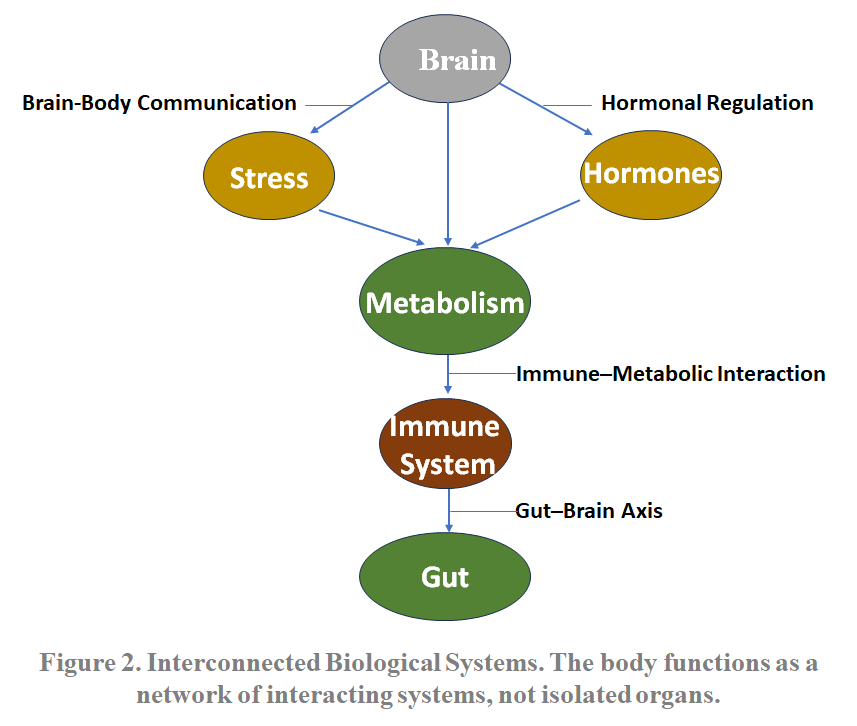
For example, the metabolic system regulates how the body processes energy and nutrients. Hormones such as insulin coordinate energy use across multiple tissues, including the liver, muscle, and adipose tissue.
At the same time, the immune system monitors the body for pathogens and tissue damage. Immune responses involve complex signaling pathways that recruit specialized cells and inflammatory molecules.
These systems do not operate independently. Increasing evidence shows that metabolic and immune processes are closely interconnected. Chronic inflammation, for instance, can influence metabolic regulation and contribute to diseases such as diabetes or cardiovascular disorders.
Another example is the communication between the brain and other organs. Neural signals regulate appetite, stress responses, hormone release, and even aspects of immune function. Recent research has also highlighted interactions between the brain and the gut microbiome, illustrating how diverse biological systems can influence one another.
From this perspective, the body resembles a network of interconnected systems rather than a collection of separate parts.
Networks, Regulation, and Biological Balance
Because biological systems are interconnected, they must be carefully regulated to maintain stability. One of the most important principles in physiology is homeostasis, the ability of the body to maintain internal balance despite external changes.
Homeostasis relies on regulatory networks that monitor physiological conditions and adjust cellular activity accordingly. For example, if blood glucose levels rise after a meal, hormonal signals trigger metabolic processes that store or utilize glucose. If body temperature increases, physiological mechanisms promote heat dissipation.
These regulatory processes often involve feedback loops, in which biological signals adjust system activity in response to changing conditions. Feedback regulation allows the body to adapt dynamically rather than remain fixed in a static state.
Importantly, biological balance is not a rigid equilibrium. Instead, it represents a constantly shifting state maintained through continuous communication among cells, tissues, and organs.
Health and Disease as System States
Viewing the body as a network of interacting systems also changes how we understand disease. Rather than resulting from a single malfunction, many diseases arise from disruptions in system-level regulation.
Consider chronic inflammation. While short-term inflammation is an essential defense mechanism against infection or injury, persistent inflammatory activity can damage tissues and disrupt metabolic regulation. Chronic inflammation has been linked to numerous conditions, including metabolic disorders, cardiovascular disease, and neurodegenerative illnesses.
Similarly, stress can influence multiple physiological systems simultaneously. Hormonal signals associated with stress affect metabolism, immune responses, and brain function, illustrating how one system can influence many others.
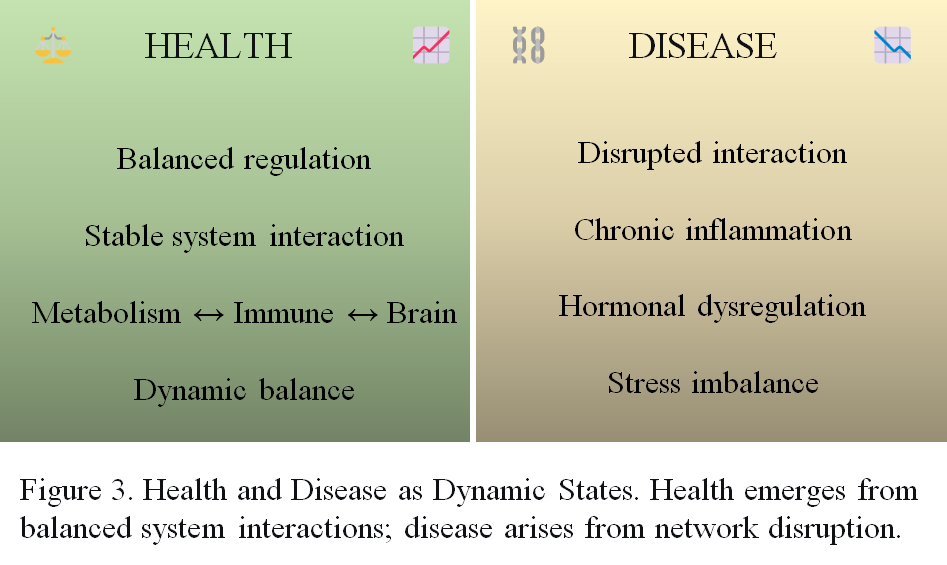
From this perspective, health and disease can be understood as states of biological networks. When regulatory systems function effectively, the body maintains balance and resilience. When interactions among systems become dysregulated, physiological stability may be compromised.
The Biomedicine Bridge
Modern biomedical science therefore requires a way to connect knowledge across different levels of biological organization. Understanding cellular mechanisms alone is not enough; we must also understand how those mechanisms operate within complex physiological systems and how these systems shape health outcomes.
The Biomedicine Bridge represents an effort to explore these connections.
Within QLUSB, this exploration unfolds across three complementary areas:
- Core Biology examines the molecular and cellular mechanisms that sustain life, including metabolism, immune function, and cellular communication.
- Systems & Integration explores how biological processes interact across organs and physiological networks, highlighting connections such as immune–metabolic interactions and brain–body communication.
- Conceptual Reflections considers broader questions about biological balance, adaptation, and the nature of health and disease.
Together, these perspectives form a bridge between molecular biology, physiological systems, and medical understanding.
By exploring these layers of biological organization, we gain a deeper appreciation for the remarkable complexity of living systems. More importantly, we begin to see how modern biomedical science can illuminate the mechanisms that support health and the disruptions that lead to disease.
The journey from cells to systems is not only a central theme in biology—it is also a powerful framework for understanding the living world.