-95x98.png)
Introduction
Living organisms are composed of trillions of cells that must constantly coordinate their activities. Although individual cells perform specialized functions, they do not operate in isolation. Instead, they communicate with one another through sophisticated signaling systems that allow the body to respond to changes in the environment and maintain internal balance.
Cell communication enables cells to share information, coordinate growth and development, regulate metabolism, and respond to threats such as infection or injury. Without these signaling mechanisms, the complex organization of multicellular life would not be possible. Understanding how cells communicate therefore provides insight into many biological processes, from immune responses to brain activity.
Concept
Cell communication refers to the processes by which cells detect signals and respond to them. These signals may originate from neighboring cells, distant tissues, or even from the cell itself.
Biological signals are usually transmitted through chemical messengers, which bind to specialized proteins known as receptors on the surface or inside target cells. Once a signal is detected, the receiving cell activates internal pathways that lead to specific responses.
Cell signaling generally occurs through several main modes:
Autocrine signaling
A cell releases signals that act on itself.
Paracrine signaling
Signals affect nearby cells in the local environment.
Endocrine signaling
Hormones travel through the bloodstream to affect distant organs.
Synaptic signaling
Nerve cells transmit signals rapidly through specialized connections called synapses.
These communication pathways allow cells to function as part of a coordinated biological network.
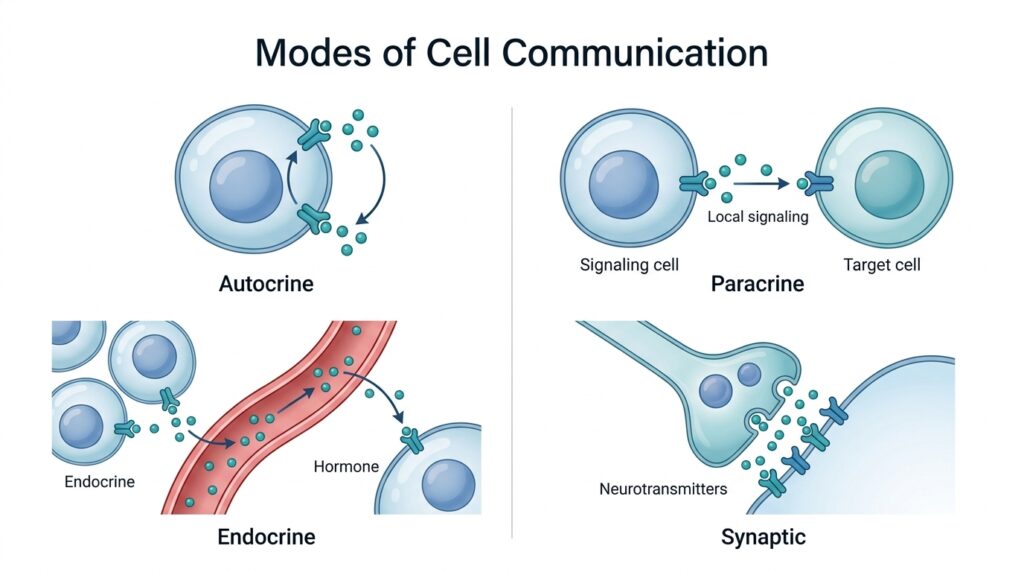
Figure 1. Major modes of intercellular communication. Intercellular communication occurs through several principal signaling modes. Autocrine signaling refers to signals that act on the same cell that secretes them. Paracrine signaling involves local mediators acting on neighboring cells. Endocrine signaling is mediated by hormones that enter the bloodstream and act on distant target tissues. Synaptic signaling enables rapid and specific transmission between neurons and their target cells through neurotransmitter release at synapses.
Mechanism
At the molecular level, cell communication follows a sequence of steps known as signal transduction. This process converts an external signal into a cellular response.
The first step is signal reception. A signaling molecule, often called a ligand, binds to a receptor protein on the target cell. These receptors are highly specific, meaning that only particular molecules can activate them.
The second step is signal transduction. After the receptor is activated, a cascade of intracellular events occurs. These events often involve enzymes, second messengers, and phosphorylation reactions that amplify the signal.
The final step is the cellular response. Depending on the signaling pathway, the cell may change gene expression, alter metabolism, release additional signaling molecules, or modify its behavior.
This multistep structure allows cells to carefully regulate biological responses and ensures that signals are interpreted correctly.
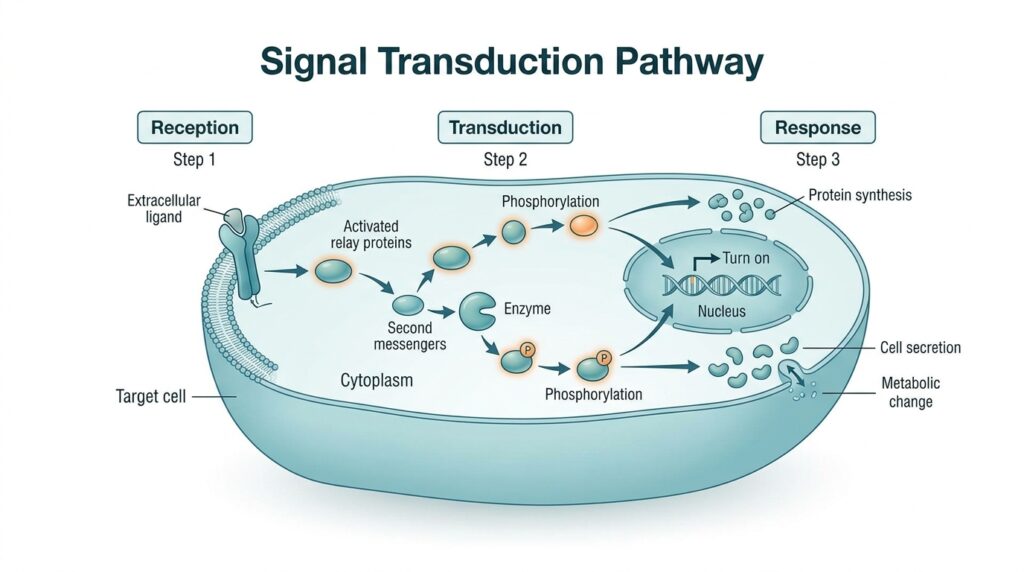
Figure 2. Schematic overview of signal transduction. Signal transduction begins when an extracellular ligand binds to a specific cellular receptor. Receptor activation initiates intracellular signaling cascades involving relay molecules, second messengers, and phosphorylation events, which transmit and amplify the signal. These events culminate in a defined cellular response, including altered gene expression, metabolic regulation, secretion, or changes in cell function.
Systems Perspective
Cell communication operates across multiple biological systems and allows organs to coordinate their activities. Hormones released by endocrine glands regulate metabolism, growth, and reproduction throughout the body. Immune cells communicate using cytokines to coordinate responses to infection. Neurons transmit electrical and chemical signals that enable perception, movement, and cognition.
These signaling networks allow distant organs to function as part of an integrated system. For example, when blood glucose levels rise after a meal, pancreatic cells release insulin. This hormone signals liver, muscle, and fat cells to absorb glucose and regulate energy metabolism.
Because signaling pathways connect many tissues simultaneously, disruptions in cell communication can affect entire physiological systems. Many diseases arise when signaling pathways become dysregulated.
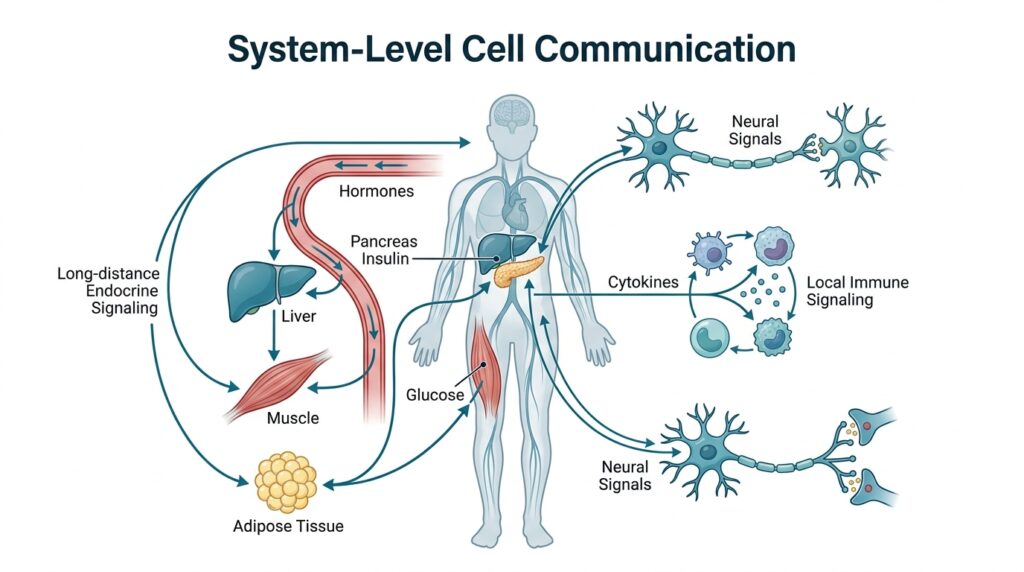
Figure 3. System-level organization of cell communication. Cell communication functions across multiple biological systems to coordinate whole-body physiology. In endocrine regulation, insulin released by the pancreas enters the circulation and acts on metabolically active tissues such as the liver, muscle, and adipose tissue. Additional signaling networks include cytokine-mediated immune communication and synaptic signaling in the nervous system. Together, these pathways integrate organ activity and contribute to maintenance of physiological homeostasis.
Health Connections
Proper cell communication is essential for maintaining health. When signaling pathways function normally, cells respond appropriately to changes in their environment. However, disruptions in these pathways can contribute to disease.
For example, cancer often arises when signaling pathways that control cell growth become overactive. In metabolic disorders such as insulin resistance, cells fail to respond effectively to hormonal signals that regulate glucose metabolism. Similarly, immune diseases can occur when communication between immune cells becomes dysregulated.
Because cell signaling is central to so many biological processes, many modern medicines are designed to target specific signaling pathways. Drugs that block receptors or modify signaling cascades are widely used in treatments for cancer, inflammation, and metabolic diseases.
Understanding how cells communicate therefore provides a foundation for both biology and medicine.
Integrative Perspective
From a broader perspective, cell communication reflects the principle that biological systems operate through networks rather than isolated components. Cells constantly exchange information in order to maintain coordination across tissues and organs.
Many traditional medical systems have also emphasized the importance of communication and balance within the body. While their conceptual frameworks differ from modern molecular biology, they often highlight the need for harmonious interactions between physiological systems.
Modern biomedical research now reveals the molecular mechanisms that underlie these complex networks of communication, helping us better understand how the body maintains stability in a changing environment.
Key Takeaways
• Cells communicate through chemical signals and specialized receptors.
• Major signaling types include autocrine, paracrine, endocrine, and synaptic communication.
• Signal transduction converts external signals into cellular responses.
• Communication networks allow organs and tissues to coordinate biological functions.
• Disruptions in signaling pathways can contribute to many diseases.