-95x98.png)
Introduction
Burns are among the most common household injuries. They can occur when the skin comes into contact with heat, hot liquids, steam, chemicals, electricity, or intense sunlight. While severe burns require immediate medical care, many minor burns can be treated safely at home with proper first aid.
Understanding the basic biology of burns and knowing how to respond quickly can reduce pain, prevent infection, and promote faster healing. This article explains what happens to the skin during a burn, how minor burns can be treated, and when medical attention is necessary.
Concept
A burn occurs when heat or another damaging agent injures the skin and underlying tissues. The severity of a burn depends on how deeply the skin is affected.
Human skin consists of several layers:
- Epidermis – the outer protective layer
- Dermis – the layer containing blood vessels, nerves, and connective tissue
- Subcutaneous tissue – deeper tissue that contains fat and larger blood vessels
Minor burns usually involve only the outer layers of the skin.
Burns are generally classified into three categories:
First-degree burns
These affect only the epidermis and typically cause redness and mild pain.
Second-degree burns
These extend into the dermis and may cause blisters and swelling.
Third-degree burns
These destroy deeper tissues and require urgent medical care.
Minor burns typically fall into the first or mild second-degree categories.Figure 1. Burns are classified by how deeply they damage the layers of the skin.
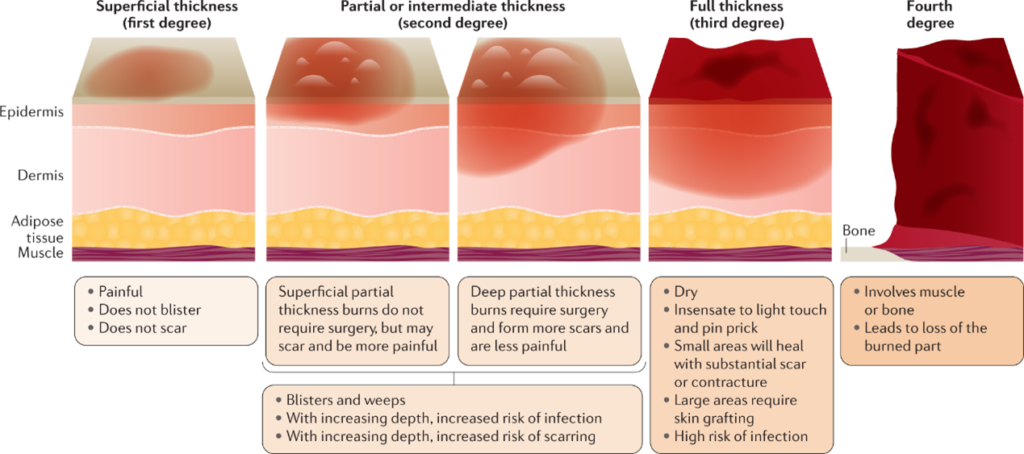
Figure 1. Classification of burns according to depth of tissue injury. Schematic representation of burn injury depth and the corresponding clinical features of superficial (first-degree), partial-thickness/intermediate (second-degree), full-thickness (third-degree), and fourth-degree burns. Superficial burns are limited to the epidermis and are typically painful, non-blistering, and heal without scarring. Partial-thickness burns extend into the dermis and may be subdivided into superficial partial-thickness and deep partial-thickness injuries; these burns commonly blister, weep, and show increasing risks of infection and scarring with greater depth. Full-thickness burns involve destruction of the entire epidermis and dermis, are typically dry and relatively insensate to light touch or pinprick, and often require skin grafting, particularly when extensive. Fourth-degree burns extend beyond the skin into deeper tissues such as muscle or bone and may result in loss of the affected part. The diagram also indicates the relative involvement of the epidermis, dermis, adipose tissue, muscle, and bone across burn severities.
Mechanism
When the skin is exposed to excessive heat, cells in the affected area become damaged. This injury triggers a protective response from the body.
Blood vessels in the damaged area expand, allowing immune cells and nutrients to reach the injured tissue. This response causes redness, warmth, and swelling.
Pain occurs because heat and inflammation stimulate nerve endings in the skin. In second-degree burns, fluid may accumulate between skin layers, forming blisters that help protect underlying tissue during healing.
As the injury begins to repair, new skin cells gradually replace damaged ones. In minor burns, this healing process often occurs within several days to two weeks.
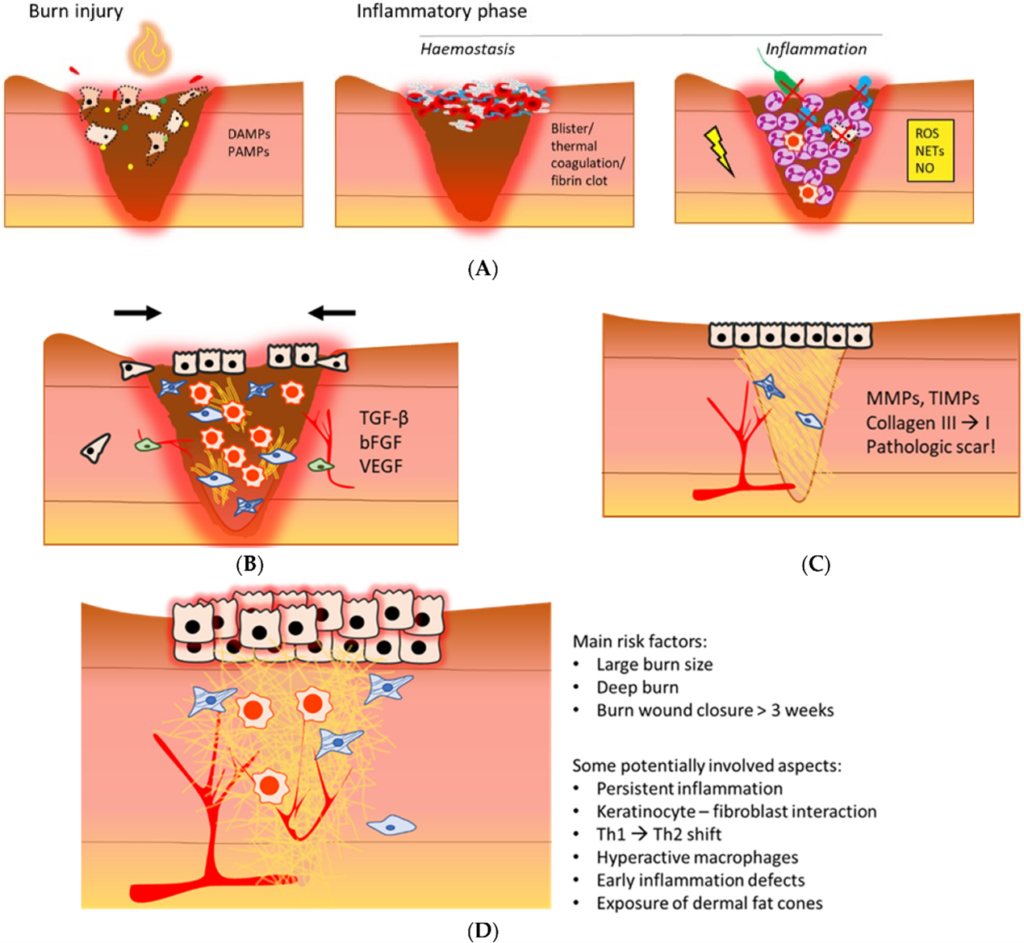
Figure 2. Burn wound healing and pathologic scar formation. Schematic of the major phases of burn wound healing. (A) Burn injury induces release of DAMPs/PAMPs, haemostasis, and inflammation. (B) The proliferative phase involves re-epithelialization, fibroblast activity, and angiogenesis, supported by TGF-β, bFGF, and VEGF. (C) During remodeling, extracellular matrix turnover and collagen transition from type III to type I are regulated by MMPs and TIMPs; dysregulation may result in pathologic scarring. (D) Major risk factors include large burn size, deep injury, and delayed wound closure.
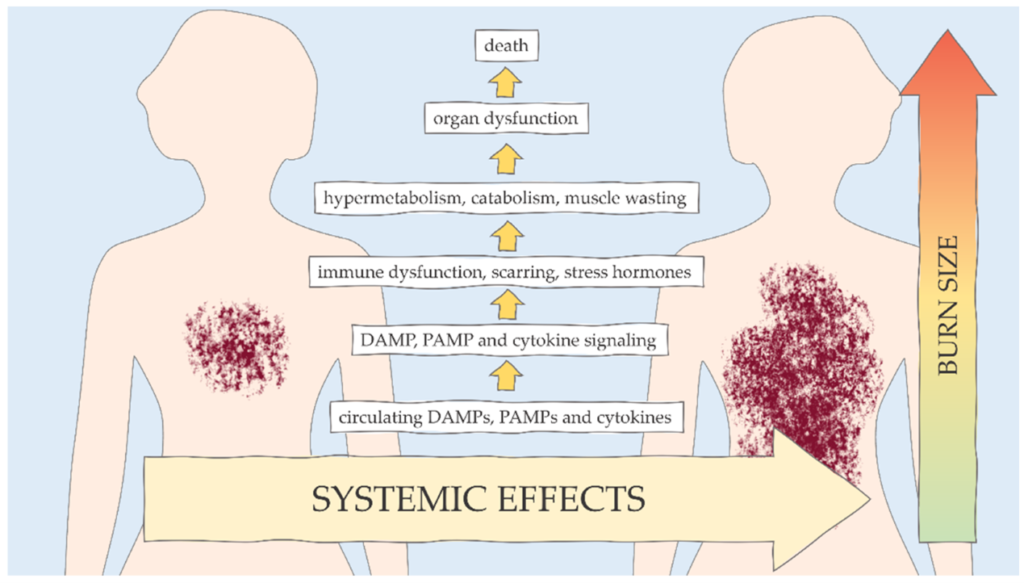
Figure 3. Systemic effects of burn injury increase with burn size, activity, and tissue repair. Schematic showing that larger burns induce greater release of DAMPs, PAMPs, and cytokines, promoting systemic inflammation, immune dysfunction, hypermetabolism, organ dysfunction, and increased risk of death.
First Aid for Minor Burns
Prompt and appropriate first aid can reduce tissue damage and improve recovery.
Step 1 – Cool the burn
Place the burned area under cool (not cold) running water for about 10–20 minutes. Cooling the skin helps reduce heat damage and pain.
Step 2 – Protect the area
After cooling, gently cover the burn with a clean, non-stick bandage or sterile gauze to protect the skin.
Step 3 – Avoid irritation
Do not apply ice directly to the burn, as this may cause further tissue damage. Avoid breaking blisters, since they help protect healing skin.
Step 4 – Keep the area clean
Mild burns should be kept clean and dry while healing. If necessary, a mild topical ointment may help protect the skin.
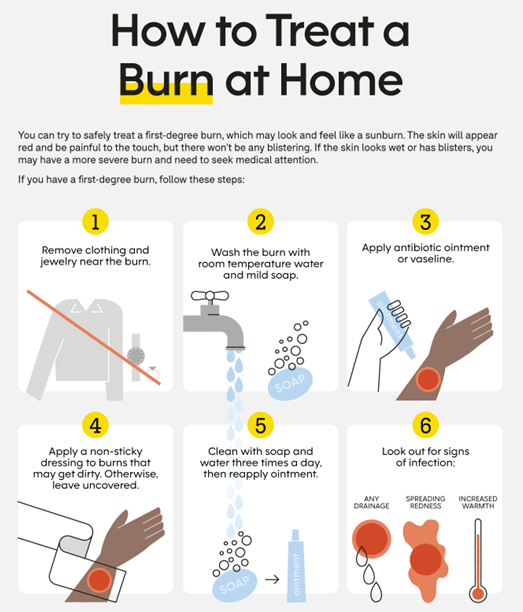
Figure 4. Home care for minor first-degree burns. Infographic showing basic first-aid steps for minor first-degree burns, including cleansing, ointment application, dressing when needed, and monitoring for signs of infection.
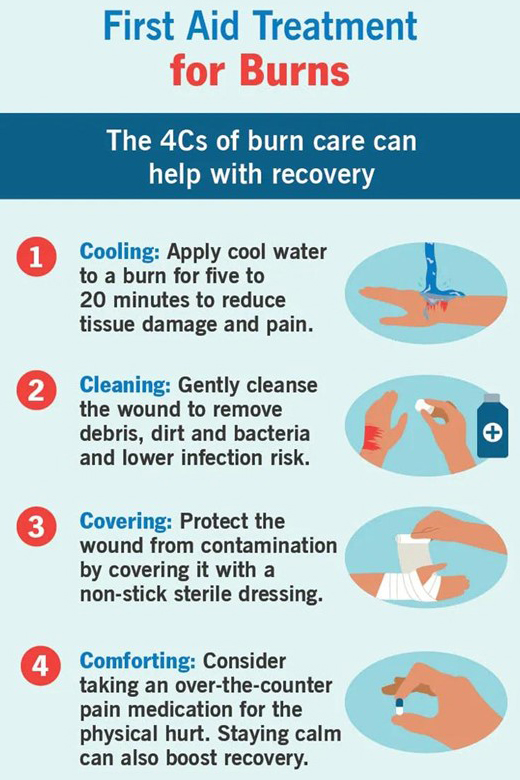
Figure 5. First aid for burns. Infographic summarizing the 4Cs of burn care: cooling, cleaning, covering, and comforting.
⚠️ Important Safety Notice
This guide is for educational purposes only and does not replace professional medical training.
In life-threatening emergencies, call 911 immediately and seek assistance from trained professionals.
When to Seek Medical Care
Although many minor burns can be treated at home, some burns require professional medical evaluation.
Medical care should be sought if:
- the burn is larger than the palm of the hand
- the burn involves the face, hands, feet, or joints
- deep blisters or white/charred skin appear
- signs of infection develop (increasing redness, swelling, or pus)
- severe pain or fever occurs
Children and older adults may require extra caution, as their skin may be more vulnerable to injury.
Key Takeaways
• Minor burns commonly occur from heat, hot liquids, or steam.
• Burns are classified according to how deeply the skin is damaged.
• Cooling the burn with running water is the most important first aid step.
• Protecting the injured area helps prevent infection and supports healing.
• Larger or deeper burns require medical attention.