-95x98.png)
Introduction
Fever is one of the most common signs of illness, especially during infections. Many people associate fever with discomfort and disease, but from a biological perspective, fever is often a protective response. When the body detects pathogens such as viruses or bacteria, the immune system may raise body temperature as part of its defense strategy.
Understanding what fever is—and why it occurs—can help people make better health decisions. In many cases, fever is a normal part of the body’s effort to fight infection. However, in some situations, high or persistent fever may require medical attention.
Learning how fever works provides insight into how the immune system protects the body.
Concept
Fever is a temporary increase in body temperature that occurs when the immune system responds to infection or inflammation.
The normal human body temperature typically stays close to 37°C (98.6°F), although it can vary slightly during the day. Fever is usually defined as a body temperature above 38°C (100.4°F).
Fever occurs when the brain resets the body’s temperature “set point.” This process is controlled by a region of the brain called the hypothalamus, which acts as the body’s temperature regulator.
When infection is detected, immune cells release signaling molecules known as pyrogens. These signals tell the hypothalamus to raise the body’s temperature.
As a result, the body begins generating and conserving heat through processes such as:
- shivering
- reduced heat loss from the skin
- increased metabolic activity
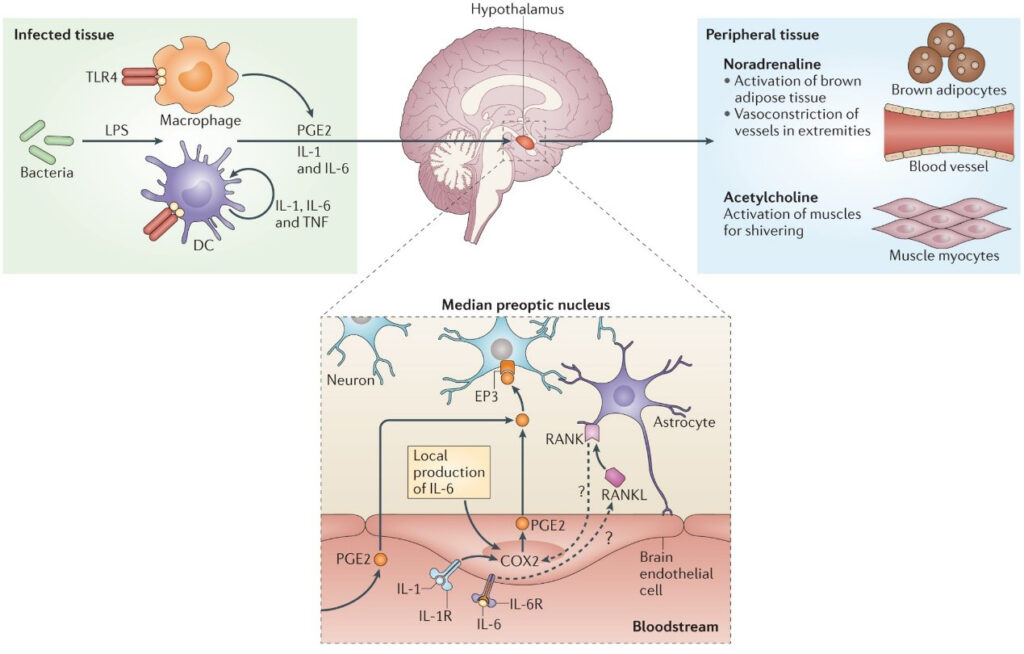
Figure 1. Infection triggers immune signaling molecules that signal the hypothalamus to raise body temperature.hese responses help elevate body temperature to a new temporary level. Peripheral infection activates innate immune cells, including macrophages and dendritic cells (DCs), through pathogen-associated signals such as lipopolysaccharide (LPS) acting on TLR4. These cells release pro-inflammatory cytokines, including IL-1, IL-6, and TNF, and promote the production of prostaglandin E2 (PGE2). Circulating cytokines and PGE2 signal to the hypothalamus, particularly the median preoptic nucleus, where brain endothelial and glial interactions further amplify pyrogenic signaling through COX-2-dependent PGE2 synthesis and related mediators. PGE2 acts on EP3-expressing neurons to alter the thermoregulatory set point, leading to activation of autonomic and somatic effector pathways. Downstream peripheral responses include noradrenaline-mediated activation of brown adipose tissue, vasoconstriction of peripheral blood vessels, and acetylcholine-dependent shivering in skeletal muscle, collectively raising body temperature and producing fever.
Mechanism
Once the hypothalamus raises the body’s temperature set point, several physiological responses begin.
First, blood vessels near the skin may constrict, which reduces heat loss. At the same time, muscles may begin to contract rapidly, producing shivering that generates heat.
As body temperature rises, immune activity may also increase. Higher temperatures can slow the growth of certain pathogens while enhancing the effectiveness of immune cells.
Eventually, once the infection is under control, the hypothalamus lowers the temperature set point again. At this stage, the body releases excess heat through sweating and increased blood flow to the skin.
These responses explain why people with fever often experience cycles of chills followed by sweating.
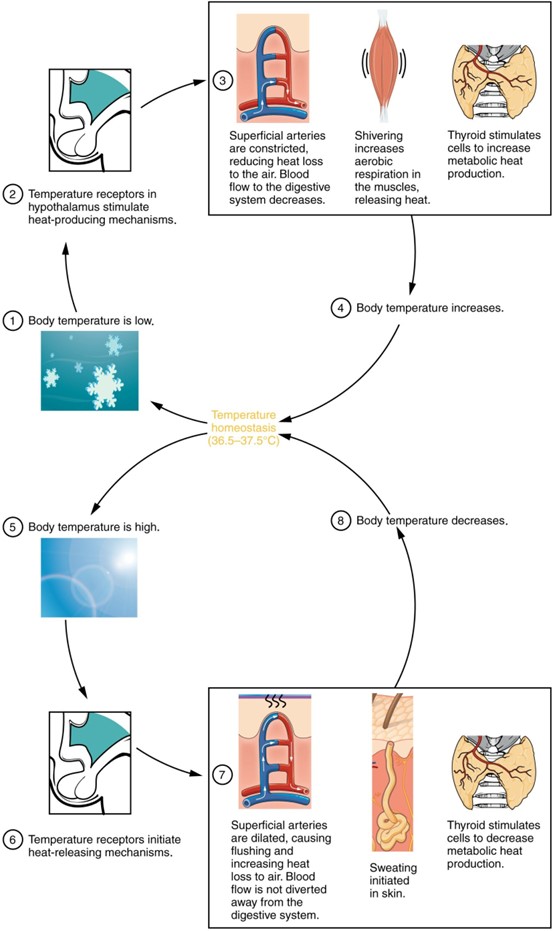
Figure 2. The hypothalamus regulates body temperature through mechanisms such as shivering and sweating. Schematic illustration of thermoregulation as a homeostatic negative-feedback process. When body temperature falls below the normal range, temperature receptors signal the hypothalamus, which activates heat-conserving and heat-generating responses, including vasoconstriction of superficial blood vessels, shivering in skeletal muscle, and increased metabolic heat production. These responses raise body temperature toward the normal range. Conversely, when body temperature rises above the normal range, thermoreceptors trigger hypothalamic pathways that promote heat loss, including vasodilation of superficial blood vessels, sweating, and reduced metabolic heat production. Together, these coordinated responses maintain temperature homeostasis within a narrow physiological range.
Systems Perspective
Fever involves coordination between several biological systems.
The immune system detects infection and releases signaling molecules. The nervous system, particularly the hypothalamus in the brain, regulates body temperature. The circulatory system helps distribute heat throughout the body.
These systems work together to produce the physiological changes associated with fever. Because fever is a coordinated response rather than a random symptom, it often indicates that the body is actively fighting infection.
However, excessive or prolonged fever may place stress on the body, particularly in young children or older adults.
-1024x559.jpeg)
Figure 3. Fever can be a helpful immune response, but very high or persistent fever may require medical care. Fever is a coordinated physiological response involving multiple biological systems. During infection, the immune system detects pathogens and releases signaling molecules that communicate with the nervous system, particularly the hypothalamus, which adjusts body temperature. The circulatory system contributes by distributing heat throughout the body, thereby supporting the systemic temperature increase associated with fever. Because fever results from regulated interactions among these systems, it often reflects an active host defense against infection. However, very high or prolonged fever may impose physiological stress, especially in young children and older adults, and may warrant medical evaluation.
Health Decisions
Most mild fevers caused by common infections resolve on their own as the immune system clears the pathogen. Rest, hydration, and monitoring symptoms are often sufficient.
However, medical attention should be considered if:
- fever exceeds 40°C (104°F)
- fever lasts more than several days
- severe symptoms appear (confusion, difficulty breathing, persistent vomiting)
- fever occurs in very young infants
Understanding when fever is a normal immune response and when it may signal a more serious condition is an important part of health literacy.
⚠️Important Safty Notice!
This website is for educational purposes only and does not replace professional medical training.
Key Takeaways
• Fever is a temporary increase in body temperature triggered by immune responses.
• Immune signaling molecules cause the hypothalamus to raise the body’s temperature set point.
• Higher body temperature can help the immune system fight infection.
• Fever often resolves as the infection improves.
• Very high or persistent fever may require medical evaluation.